SUBSYSTEM REPORTS
NAVIGATION PERFORMANCE:
ACTIVITIES:
Today the rover performs the following activities: retracts APXS, moves
back 60mm, does soil mechanics on Mermaid Dune, images disturbed soil,
goes to near Squid and Hassock, captures Squid images and goes to another
waypoint toward Rock Garden.
-
Vehicle initial position:
- Rover thinks: (-5622, 2868, 357.5)
- Driver thinks: (-5612, 2847, 358.0)
-
Cmd #29031: Run motor 10 to 0, to retract APXS; completed, no errors.
-
Cmd #29053: Soil mechanics, motor #4, 500 cnts, 6 cycles; completed,
no errors.
-
Cmd #29056: Move -600mm, completed, no errors. Z accel showed anomalous
readings.
-
Cmd #29058: Soil mechanics, motor #1, -500 cnts, 6 cycles; completed, no
errors.
-
Cmd #29059: Move -100mm, completed, no errors.
-
Cmd #29061: Soil mechanics, motor #4, 500 cnts, 6 cycles; completed, no
errors.
-
Cmd #29071: Move 700mm, incompleted, Err 0xF01: Y accel exceeded its
navigation limit (Ylimit = +/-195cnts or +/-30degs). The
Y accel value when it triggered was -385cnts or ~80degs.
-
The rover completed soil mechanics tests at Mermaid Dune. It also
completed the first two move commands and failed at the third one
due to Y accel exceeded its limit. The Y accel showed anomalous
readings at the two extreme. It returned to -0.141g or -21.7 degs
and stuck at this indication for about an hour (from 20:18:10 to 21:19:16)
before returned to normal readings. This was the first time that the
Y accel readings remained the almost at the same level for more
than an hour before it returned to reasonable readings.
-
The rover current position:
- Rover thinks: (-6212, 2850, 4.7)
- Driver thinks: (???)
CONSTRAINTS:
- Do health check level 2 after every vehicle movement.
- Set Z accel to FORCED_BAD for all vehicle movements.
- Set Y accel to FORCED_BAD for RISK LEVEL = 1 vehicle movements.
- Set Y accel to OK for RISK LEVEL = 2 vehicle movements.
- IF navigation sensor limit bit set to ENABLE in HAZ_AVOIDANCE
parameter (to avoid navigation command errored out because of
Y accel exceeding navigation limit), the following considerations
should be taken in to account:
- * set command TIME OUT longer to allow the vehicle finishes up
the command.
- * check for clearance behind the vehicle at starting position,
the vehicle might back up half of the vehicle length (300mm)
if hazard avoidance somehow triggers just right after the
navigation command starts.
THERMAL PERFORMANCE:
-
Temperatures are a bit lower today since yesterday was just runout.
-
Sol 28 pm Max recorded: 39.9 PWR, 38.5 CPU, 6.4 MAE
-
Sol 29 am Min recorded: -25.7 WEB, -19.5 CPU, -82.9 MAE
-
Sol 29 pm Max recorded: 36.0 PWR, 35.5 CPU, 7.1 MAE
-
Sol 30 am Min recorded: -27.3 WEB, -21.0 CPU, -64.4 MAE
-
The RF temperature sensor is still bad and remains forced failed.
Recommendations:
TELECOM PERFORMANCE
Telecom system performance was good this sol, and the revised rover modem heating strategy first
implemented on Sol 27 was effective.  A review of the data plots for this sol again shows correlaion
between poor rover-to-lander communication throughput and rover modem temperatures below roughly
+20 C.  There are indications that one, and perhaps two, modem reheating cycles were initiated
automatically by the rover after experiencing excessive retries on the rover-to-lander link.

The end-of-sol communication system performance was as follows:

End of second downlink Rover Modem Temp =       29.5 C
End of second downlink LMRE Temp =              25.9 C
Rover RX Current =                              49.30 mA
Rover TX Current =                             162.4 mA
Avg LMRE Link Quality =                         45.9 %    <<

Note (1) the unusually high LMRE (and, hence, Lander Battery) temperature, and (2), that althoughthere
was a third downlink on this Sol (a second session on the High Gain Antenna), all the relevant roer
engineering and rover imaging data had come down by the close of the second downlink.

In planning the sequence for Sol 32 and beyond (because there is no uplink on Sol 31), the revise modem
heating strategy first used on Sol 27 (and which has been in place since that Sol) should be follwed:

The rover modem should be commanded in the next-day runout sequence to perform a 600 second modemheating at wakeup.  If no overnight APXS operations are to be conducted, the wakeup rover modem
heating should be extended to 900 seconds.  Modem reheating should be triggered by an excessive nmber
of frame retries on the rover-to-lander link, and the reheating should continue for five minutes r until the
rover modem reaches +30 C.  The sequence planners should consider the uncertainty in event compleion
times introduced by any required modem reheating cycles.

We are continuing our suspension of the previous recommendation to operate on LMRE-A for ten minues
prior to the expected rover wakeup time.
MOBILITY PERFORMANCE:
-
Due to Lander difficulties, the Sol 29 sequence was not received on Sol 29.
The revised 53010 Sol 30 sequence with 29000 series command numbers was picked
up and executed on Sol 30. Sol 29 runout ran nominally.
-
The APXS was retracted nominally per command 29031
-
Soil mechanics and move commands ran nominally until a Y-accel error on
Move 29071. We ended up approximately 0.6 meters behind our EOD 28 position.
The Y-accel provided anomolous readings for an hour after the error.
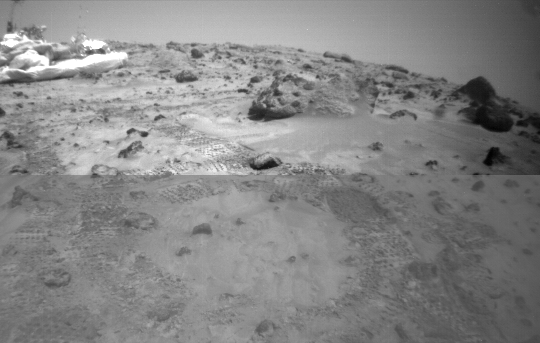
All soil data downlinked today. Both LR wheel spins show a consistent sinkage.
Imagery suggests that the Rover had significant slippage while backing up over
Mermaid dune. The soil spin 29053 should be visible AHEAD of spin 29058 in
image 29065. However, it is not visible at all. Neither is the ring
from the APXS. The only explanation I can offer is that the vehicle slipped
dramatically and did not back up 700 mm.
-
The mobility system is healthy.
-
Daily Odometry: 0.815 m
-
Total Odometry: 051.921 m
-
Average Wheel Odom: 73.409 m
Recommendations:
- Consider enabling avoidance of stall hazards.
POWER PERFORMANCE:
Based upon the data returned in the health checks returned in SOL 29/30,
the Power Subsystem is in good health with no operational problems noted.
The trend for the MAE short circuit current cell prediction of power output
capability of the solar panel continues to be in the direction on less power.
This trend is in agreement with the lander short circuit current cell readings
and the power available to the Lander.