Summary Report
Retransmit Requests
Sequence Planning Recommendations & Constraints
Sequence Execution Status
Telemetry Volume
Traverse Hazards (Detected)
Subsystem Reports
Telemetry Processing Anomalies
Press Release
Last updated: 8 Sep 1997, 16:00 PDT, Data Controller: Howard J. Eisen
|
Summary Report |
|
Sequence 56410C:
Operational Constraints (for Sol 66 Sequence):
Operational Constraints (General):
SEQUENCE EXECUTION STATUS (EOD Sol 65):
VEHICLE STATE:
(AS OF COMMAND: 0, Auto Level 2 Health Check during Wait 14186
BATTERY STATE/USAGE(AS OF EOD SOL 65)
BATTERIES DEPLETED
SUBSYSTEM STATUS (AS OF EOD SOL 65):
NAVIGATION PERFORMANCE:
THERMAL PERFORMANCE:
TELECOM PERFORMANCE
Telecom system performance was poorer than expected for such a small data volume, there are no telecom operational constraints for future rover operations.
MOBILITY PERFORMANCE:
POWER PERFORMANCE:
TBD
Web Page Authors: Henry W. Stone and
Allen.R.Sirota All information on this site, including text and images describing the
Rover is copyright © 1997, Jet Propulsion Laboratory, California Institute of Technology and the National Aeronautics and Space Administration.
SUMMARY REPORT
RETRANSMIT REQUESTS
SEQUENCE PLANNING RECOMMENDATIONS
Proceed with NOMINAL planning. Be aware no Persistent State Table or
Level 3 HC available today.
Engineering Requests:
SEQUENCE EXECUTION STATUS & VEHICLE STATE
Execution: Nominal
State: Running
Wakeup: Sol 65 unknown
Crit Errors: None
Executing sequence 56410C
SCET: 9/8/97 19:57, MLST: Sol 65 11:36
)
Mission Phase: Primary
Mode: Executing
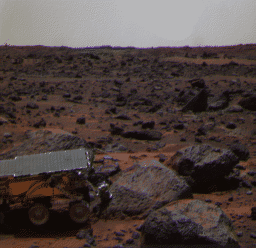
Config: APXS Deployed onto Moe
Device Status: Gyro force failed
Z accel force failed
RFW temp. force failed
Batteries Force Failed
Temp (Internal): Nominal
Temp (External): Nominal
Temp:(Modem): Nominal
   Parameter     Initial      Final    IMP EOD    Parameter    Initial     Final
---------------------------------------------------------------------------------
X Position (m)   -4.576      -4.576       ?      LBogie (deg)  + 2.72     + 2.72
Y Position (m)   -4.041      -4.041       ?      Rbogie (deg)  - 1.68     - 1.68
Heading   (deg)  +129.5      +129.5       ?      Diff   (deg)  + 1.36     + 1.28

Pitch    (deg)    + 4.7      + 5.9     (+ Pitch -> Front down)
Roll     (deg)    + 8.3         ?      (+ Roll  -> Roll to Starboard)

ADM Pos  (deg)    101.12    -101.12     (deployed)

LFS      (deg)      0.0        0.0              RFS    (deg)    -0.6       -0.6
LRS      (deg)      0.0        0.0              RRS    (deg)    -1.3       -1.3
--------------------------------------------------------------------------------
CONTACT STATE
ADM Bumper Solar
UL UR B RB LB LR RR RF LF
Mask 1 1 1 1 1 1 1 1 1
State 0 1 0 0 0 0 0 0 0
ERROR FLAGS
Skip GenFail InvalidCmd WEB_Hot NoPwr NonTrav DevNA DevFail Timeout
Mask 1 1 1 1 1 1 1 1 1
State 0 0 0 0 0 0 0 0 0
S/S Status Comments
C&N Nominal Y accel reading WAY off.
MTM Nominal None
Thermal Nominal None
Power Nominal Batteries Depleted
Telecom Nominal None
TRAVERSE HAZARDS (DETECTED)
None.
TELEMETRY VOLUME
DATA VOLUME SUMMARY (BY APID)*

APID   #PKTS     #BYTES    #Mbits
----------------------------------
  4        2       584     0.00467
  5        7       240     0.00192
  6        0         0     0.00000
  7        1        88     0.00070
  8        0         0     0.00000
  9        0         0     0.00000
 10        0         0     0.00000
 12       14     14980     0.11984
 23        0         0     0.00000
 24        0         0     0.00000
 25        0         0     0.00000
 29        0         0     0.00000
----------------------------------
          24     15892     0.12714
*All data downlinked on this Sol INCLUDING retransmitted data.
SUBSYSTEM REPORTS
Y accelerometer shows anomolous readings.
Nominal Thermal Performance
The end-of-sol communication system performance for the downlink was as follows:
SOL 65 DOWNLINK TELECOM STATISTICS
Rov Radio Temp Low =	-4.1
Rov Radio Temp High =	40.2
Rov Radio Temp Avg =	14.8
LMRE Radio Temp Low =	15.2
LMRE Radio Temp High =	19.6
LMRE Radio Temp Avg =	17.3
Rx Current Low =	46.4
Rx Current High =	46.4
Rx Current Avg =	46.4
Tx Current Low =
Tx Current High =
Tx Current Avg =	0.0
LMRE Good Frames =	96
LMRE Garbled Frames =	374
Avg LMRE Link Quality%=	20.4
TX_CH_FRAMES =	33
RX_CH_FRAMES =	33
Total Frame Resends =	0
Avg Rover Link Quality%=	100.0
COM:Bad CRC Errors =	18
COM:Timeout Errors =	52786
COM:Rx Abort Errors =	742
COM:No Sync Errors =	4
COM:RX Com Errors =	38715
In planning the sequence for Sol 66 and beyond, the revised modem heating strategy used should be followed:
For rover wakeups on solar power, modem heating is only needed if communications is needed in the morning. In this situation set modem heating to 0 and reheat to 300 seconds. Also, if there are afternoon only downlink sessions, then no modem heating is required after wakeup on solar. The rover modem should be commanded in the next-day runout sequence to perform a 300 second modem reheat at wakeup. Later in the day, modem reheating should be triggered by an excessive number of frame retries on the rover-to-lander link, and the reheating should continue for five minutes or until the rover modem reaches +30 C. However, if the LMRE radio is off, then the reheat to get to +30C is not needed. This requires some coordination of timing between the LMRE ON times and the rover transmissions. The sequence planners should consider the uncertainty in event completion times introduced by any required modem reheating cycles.
Mobility Subsystem continues to appear healthy.
With the exception of the battery, which was depleted on SOL 56, the remainder
of the Power Subsystem is in good health.  The power subsystem continues to
operate only on solar power.  There were no new operational problems noted in
the SOL 65 telemetry.
TELEMETRY PROCESSING ANOMALIES
Rover CPT file must not contain updated values for Level 2 Articulation Hazard in
virtual channel R-1903.
PRESS RELEASE