FLIGHT
SOL 81 END-OF-DAY DOWNLINK STATUS REPORT


Last updated: 24 Sep 1997, 23:55 PDT, Data Controller: Howard J. Eisen

Summary Report
Retransmit Requests
Sequence Planning Recommendations & Constraints
Sequence Execution Status
Telemetry Volume
Traverse Hazards (Detected)
Subsystem Reports
Telemetry Processing Anomalies
Press Release


Still soaking up X-rays


Contact with Chimp


SUMMARY REPORT


Sequence 58010B:

Sequence 58110B:

  • Lander Petal 2 temp sensor not working.

    RETRANSMIT REQUESTS


    SEQUENCE PLANNING RECOMMENDATIONS

    Operational Constraints (for Sol 82 Sequence):

    1. New or changed recommendations:
      • Do NOT enter a Wait immediately after a synch clock in the morning. Use some command which generates an immediately time-tagged acknowledgement so we can determine the error in the previous times (e.g. a Clear command)
      • Take a forward image before leaving. (Scott said "Get it, dammit!")
      • Consider engineering requests with traverses for next several days.
      • DRIVE!!!!!

    Engineering Requests:
    1. HAVE S0050 IMAGES TAKEN DURING WAYPOINT COMMANDS ... ESPECIALLY WHEN DRIVING OVER ROUGH TERRAIN!
    2. S0050 images at Low-Compression (3:1).
    3. (DESIRE) Take rover images as early in the morning as possible to reduce dark noise current.
    4. (DESIRE) Leave rover on until 15:45 LST to collect late afternoon thermal data, perform health check just before shutdown.
    5. (DESIRE) Perform Wheelie before start of Traverse and Soil Experiment at end of Sol's traverse when practical

    Operational Constraints (General):

    1. No Battery Mission
      • Do not perform APXS (and 'hold_comm') beyond 14:30 LST
      • Do not turn on APXS when heating expected as limiter reaction time may not be fast enough to prevent loadshed.
      • Limit Imaging to 09:30 to 14:30.
      • Limit Driving to 10:00 to 14:30.
      • Do not use relative waits while in hold_comm
      • Try to complete major operations by 14:30 MLST
      • When shutting down for the night command the vehicle to wakeup at 07:30 LST the next morning. This is important from a telemetry standpoint in that it will limit the degree to which our telemetry plots are scrambled.
      • The ONLY time the vehicle should be "shutdown" is at the end of the day.
      • DO NOT perform Level 3 Health Checks prior to 9:00 or after 15:00.
      • Disable battery usage for all devices.
    2. It is recommended that prior to executing a Deploy APXS command when the APXS may already be in contact the APXS should first be retracted by about 10 degrees to make up for the inherent 8-10 degrees of motion that will always occur during the beginning of the APXS Deploy command.
    3. Make sure sequence has as many days of runout as possible (analogous to the design of the 54910B sequence.
    4. Accelerometers
      • DISABLE the Y accelerometer during moves and waypoints at risk level 1
      • CAN DISABLE the Y accelerometer during moves at risk level 2 ONLY IF planned path appears 'safe'; otherwise ENABLE Y accelerometer.
      • ALWAYS ENABLE Y accel for waypoints at risk level 2
      • Leave X accelerometer ENABLED
      • Leave Z accelerometer DISABLED
    5. Heating
      • Do not heat and run APXS at the same time
      • Set modem Heat and Reheat parameters both to "0" prior to shutting down for the night if LMRE is NOT going to be turned on prior to expected rover solar wakeup of ~7:15 LST. Reset them back to normal values on the morning of "runout" Sols.
      • Set Modem Heat to 15 minutes normall, 0 minutes if sequence to be queued after 12:00 LST
      • Set Modem Reheat to 5 minutes and maximum modem reheat temperature 30 deg
      • Enable Modem Heat and Reheat only when LMRE is ON.
      • Perform WEB heating on days of low activity (i.e. no traverses) and Runouts.
      • Use Web_Heat_B parameter with Max temp of +30C from 12:30 to 15:00 when WEB heating.
      • Set Web_Heat_B parameter to -30C (-273) when not heating.
      • Always leave Web_Heat_A parameter at +40C (1197).
      • Limit image transfer after 1:00 LST (to prevent overheating)
    6. Traverses
      • Do NOT move with Bogie potentiometers disabled.
      • Enable hazard avoidance using sensors, contacts, and laser proximity, and perform each waypoint command only once.
      • Limit each "Move Command" distance to 0.5 meter or less to enable gyro to be recalibrated and thereby reduce the amount of drift.
      • Before beginning traverses, should back up a little (~ 10 cm) to enable lasers to detect hazards which may be very close to the front of the rover. UNMASK contact sensors for this move. May want to then move forward ~ 1 cm, with contact sensors MASKED to remove any contact that may have been made during the previous backward move. Then UNMASK all contact sensors and plan subsequent waypoints.
      • When performing long waypoint traverses with "thread-the-needle" enabled like that performed on Sol 35, break the waypoints up such that the last segment is performed with "thread-the-needle" disabled. This way the vehicle will make sure (most likely) that it ends up in a location in which it can safely turn in place without climbing on nearby obstacles. If the vehicle stops because it can not find a path as wide as the turn circle, subsequent turn commands will be skipped ... and we may be able to avoid the situation we ran into on Sol 36.
    7. Health Checks
      • Change HC after LoadShed Reset to Level 2 instead of Level 3.
      • DO NOT perform Level 3 Health Checks prior to 9:00 or after 15:00.
      • If need to perform Level 3 health checks between Sol n, 20:00 LST and Sol n+1,8:00 LST, disable lasers (i.e., never power) to prevent them from being turned on. Re-enable afterwards.
      • Always command a Level 2 Health Check before shutdown.
      • Perform level 2 health check at the end of every traverse command
      • If possible, health checks should not be skipped as a result of traversable hazards.
    8. Mask all errors (except INVALID CMD) immediately prior to "Read Mem" of persistent state table. Unmask accordingly immediately afterwards.
    9. Perform Read Memory just before last downlink session
    10. Perform Sync Clock just prior to EOD shudown (or LMRE off) after Clear Errors.
    11. DISABLE RF Wheel Temperature Sensor
    12. Insert longer wait (10 seconds) between APXS cycle start command and APXS turn-off command (turn off devices)
    13. Future soil mechanics experiments in suspected hard material should have 6 spins of 500 counts rather than 4.


    SEQUENCE EXECUTION STATUS & VEHICLE STATE

    SEQUENCE EXECUTION STATUS (EOD Sol 81):


    VEHICLE STATE: (AS OF COMMAND: auto HC following 31026
    SCET: 9/25/97 04:51, MLST: Sol 81 9:59 )


    BATTERY STATE/USAGE


      CONTACT STATE
      ADMBumperSolar
      ULURB RBLBLRRRRFLF
      Mask 1 1 1 1 1 1 1 1 1
      State 0 1 0 0 0 0 0 0 0


      ERROR FLAGS
      SkipGenFailInvalidCmdWEB_HotNoPwrNonTravDevNADevFailTimeout
      Mask 1 1 1 1 1 1 1 1 1
      State 0 0 0 0 0 0 0 0 0


    SUBSYSTEM STATUS (AS OF EOD SOL 81):

      S/S Status Comments
      C&N Nominal None
      MTM Nominal None
      Thermal Nominal None
      Power Nominal Batteries Depleted
      Telecom Nominal None


    TRAVERSE HAZARDS (DETECTED)


      None


    TELEMETRY VOLUME


      DATA VOLUME SUMMARY (BY APID)
      
      APID   #PKTS     #BYTES    #Mbits
      ----------------------------------
        4       17      4983     0.03986
        5       95      3295     0.02636
        6        2       120     0.00096
        7        6       384     0.00307
        8       48     82706     0.66165
        9        0         0     0.00000
       10        0         0     0.00000
       12        9      9611     0.07689
       23        0         0     0.00000
       24        0         0     0.00000
       25        0         0     0.00000
       29        0         0     0.00000
      ----------------------------------
               177    101099     0.80879
      
      *All data downlinked on this Sol INCLUDING retransmitted data.


    SUBSYSTEM REPORTS


    NAVIGATION PERFORMANCE:

      ACTIVITIES:

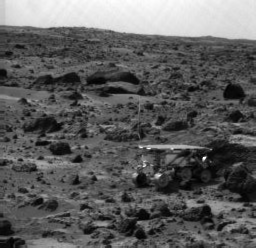
      Short downlink, therefore no rover driving for the day, continue APXS on Chimp.

    • The rover current position:

      • Rover thinks: (-8961, -2331, 65.1)
      • Driver thinks: (-8961, -2331, 65.1)
      • Total driving distance of the day: 0.0 m
      • Total driving distance since landing: 104.301 m

      All accels showed no anomalous readings.

      CONSTRAINTS:

      • Set Z accel to FORCED_BAD for all vehicle movements.
      • Set Y accel to FORCED_BAD for short vehicle movements.
      • Set Y accel to FORCED_BAD if traversing at risk level 2 and path appears to be safe otherwise set Y accel to OK.
      • ALWAYS set Y accel to OK in go to waypoint commands.
      • If risk level 2 is set, then the articulation hazard is disable (i.e. driving at your all risk!!!).
      • Plan the Move command with distance 0.500m or less to avoid gyro drift.
      • Do health check level 2 after every vehicle movement.
      • IF navigation sensor outside limit bit is set to ENABLE in HAZ_AVOIDANCE parameter (to avoid navigation command errored out because of Y accel exceeds navigation limit), the following considerations should be taken in to account:
        • Set command TIME OUT longer to allow the vehicle finishes up the command.
        • Check for clearance behind the vehicle at starting position, the vehicle might back up half of the vehicle length (300mm).

    THERMAL PERFORMANCE:

      Thermal Performance Nominal

    TELECOM PERFORMANCE

      Report Pending

    MOBILITY PERFORMANCE:

      No mobility today

    • Daily Odometry: 0.0 m
    • Total Odometry: 104.301 m
    • Average Wheel Travel: 150.69 m

    POWER PERFORMANCE:

      Report Pending


    TELEMETRY PROCESSING ANOMALIES
      TDS problem at 97/268-04:42:55. Manual processing of tds.out was necessary.


    PRESS RELEASE

    TBD


    Web Page Authors: Henry W. Stone and Allen.R.Sirota

    All information on this site, including text and images describing the Rover is copyright © 1997, Jet Propulsion Laboratory, California Institute of Technology and the National Aeronautics and Space Administration.