SUBSYSTEM REPORTS
NAVIGATION PERFORMANCE:
ACTIVITIES:
-
Rover starting position:
- Rover thinks: (3258, 1064, 285.5)
- Driver thinks: (3240, 955, 294.0)
-
Cmd #18039: Turn to heading 285degs; completed, no errors.
-
Cmd #18041: Move 500mm; completed, no errors. X, Y and Z accels showed
anomalous readings (Xmin=-0.109g, Xmax=0.094g; Ymin=-0.016g,
Ymax=0.188g; Zmin=0.266g, Zmax=0.391g)
-
Cmd #18046: Move -200mm; completed, no errors. Z accel showed anomalious
readings (zmin = 0.266g, Zmax=0.406g)
-
Cmd #18058: Turn to heading 273 degs; completed, no errors. Z accel showed
anomalious readings (Zmin=0.304g, Zmax=0.406g)
-
Cmd #18060: Move 1000mm; completed, no errors. Z accel showed
anomalious readings (Zmin=0281g, Zmax=0.453g)
-
Cmd #18062: Move 1000mm; completed, no errors. X and Z accels showed
anomalous readings (Xmin=-0.047g, Xmax=0.094g; Zmin=0.281g,
Zmax=0.453g)
-
Cmd #18067: Move -300mm; completed, no errors. X and Z accels showed
anomalous readings (Xmin=-0.109g, Xmax=0.109g, Zmin=0.312g,
Zmax=0.438g); (or pitch=+/-16.7dgs)
-
Cmd #18091: Turn to heading 215degs; completed, no errors.Z accel showed
anomalious readings (Zmin=0312g, Zmax=0.391g)
-
Cmd #18093: Move 0 mm (straighten steerings); completed, no errors.
-
Rover final position:
- Rover thinks: (3286,-905, 214.8)
- Driver thinks: ???
CONSTRAINTS:
-
Leave X accel enabled
-
Disable Z accel
-
Enable Y accel for long motion commands and disable Y accel
for short motion commands
-
Command health check level 2 after every motion command (i.e.
move, turn, waypoint, soil, APXS deploy, position APXS)
-
Limit MOVE command to 1000mm or less to allow the gyro to
recalibrate every ~100sec.
THERMAL PERFORMANCE:
Rover heating the last two days has resulted in temperatures very close to FA.
This is due in part to Sol 17 heating extending to 15:30 LST instead of the
requested 15:00. Nighttime thermal conditions are nominal.
-
Sol 17 pm Max recorded: 39.9 PWR, 39.3 CPU, 8.7 MAE
-
Sol 18 am Min recorded: -26.5 WEB, -20.2 CPU, -69.8 MAE
Recommendations:
-
Terminate heating at 15:00, not 15:30!
-
Use Web_Heat_B parameter instead of Web_Heat_A.
-
Always command a Level 2 Health Check before shutdown.
COMMUNICATIONS PERFORMANCE:
Telecom system performance was good this sol, and the rover modem heating strategy recommended for
this sol appears to have been particularly effective. One Imaging command, SEQ# 18100, does not appear
in the downlink, and it is not clear whether this data made it across to the Lander. There is no evidence,
either before or after SEQ#18100, of a breakdown of the communication link between the rover and the
lander which could be used to explain the absence of this image. The second HGA downlink session with
the Lander was not accomplished today, and for that reason the second Level 3 Healthcheck of the sol was
not received on Earth.
Preliminary end-of-day communication system data shows:
End of downlink Rover Modem Temp = 22.6 C
End of downlink LMRE Temp = 17.4 C
Rover RX Current = 46.40 mA
Rover TX Current = 147.9 mA
Avg LMRE Link Quality = 57.7 % <<
In planning the sequence for Sol 19 and beyond, special emphasis should be given to strict adherence to
the recommended heating regimen for the rover modem. The rover modem should be commanded to
perform a 600 second modem heating at wakeup and a 300 second modem reheating prior to the
transmission of large blocks of data such as images. If no overnight APXS operations are to be conducted,
the wakeup rover modem heating should be extended to 900 seconds. Our goal is to get the rover modem
above 25 C and preferably close to 35 C for those time periods when fully stuffed frames are being
transmitted. It was pleasant to see these recommendations incorporated in the sequence uplinked for this
sol. As for the LMRE modem, a review of the telemetry from previous days could not demonstrate any
advantage gained by our requested early-morning LMRE heating cycle, and we are continuing our
suspension of the previous recommendation to operate on LMRE-A for ten minutes prior to the expected
rover wakeup time.
MOBILITY PERFORMANCE:
The Rover continued its trend of excellent mobility performance today.
All motor currents were very low (36mA max per HC's). The rover encountered
several small obstacles along the way (~8 cm) and went over a mound (Cabbage
Patch) encountering slopes of +/- 15 degrees.
Several X and Y accelerometer spikes were observed.
The RF temperature sensor intermittently reports bad data indicating an open
circuit.
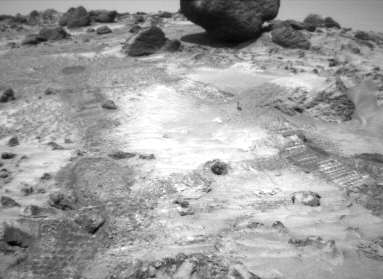
Soil mechanics spins were performed per plan in the cabbage patch and in the
material near Yogi. Both surfaces were quite hard and wheel sinkage was minimal.Rover images caught the site with the left camera but not the right.
Daily Odometry: 3.162 m
Total Odometry: 22.014 m
Average Wheel Odom: 33.78 m
Recommendations:
- Use S0350 (Today would have been PERFECT for it)!
- Use S0355!
POWER PERFORMANCE:
Based upon the data returned in 108 health checks between 12:22:59 TLST on
SOL 14 and 14:03:11 TLDT on SOL 18 the Power Subsystem is in good health with
no operational problems noted. This covers health checks for some of the
earlier time that had not been available and was recieved on SOL 18.
PRESS RELEASE
Today the Sojourner left the vicinity of Scooby-Doo travelling approximately 2 meters to the west. A soil experiment was performed at the end
of the traverse and images of the site from the rover were successfully received.
Web Page Authors: Henry W. Stone and
Allen.R.Sirota
All information on this site, including text and images describing the
Rover is copyright © 1997, Jet Propulsion Laboratory, California Institute of Technology and the National Aeronautics and Space Administration.