SUBSYSTEM REPORTS
NAVIGATION PERFORMANCE:
ACTIVITIES:
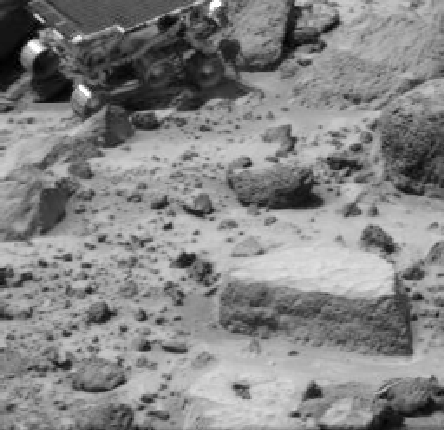
Attempt to APXS Half Dome rock if APXS successfully forms contact with
rock.
-
Vehicle initial position:
- Rover thinks: (-5434, -3041, 62.1)
- Driver thinks: (-5352, -2927, 56.3)
-
Cmd #3034: Move forward distance 200mm; completed, no errors.
-
Cmd #3036: Deploy APXS to 0; completed, no errors.
-
Cmd #3043: WAE experiment; completed, no errors.
-
Cmd #3045: Run motor in reverse for 6000 counts; incompleted. Error 0x905:
motor current exceeded its current driving limit (motor current
was 203mA at the time of the abort (limit was set at 190mA).
-
Cmd #3046: WAE experiment; skipped due to the above error.
-
Cmd #3052: Move 500mm; completed, no errors. The previous error was cleared
and this command was performed successfully. The Y accel showed
some anonalous readings, so did the Z accel.
-
Cmd #3054: Turn to heading 88 degs; completed, no errors.
-
Cmd #3057: Deploy APXS to -750; completed, no errors. Get ready for docking
the rock.
-
Cmd #3058: Move backward 900mm; completed, no errors. Finished the move
without placing the APXS on rock.
-
Cmd #3060: Deploy APXS to -500; completed, no errors. Retracted APXS a little
bit.
-
Cmd #3061: Move backward 200mm; completed, no errors. Tried to place APXS
on rock. X accel read 35.1 degs at one time.
-
Cmd #3063: Deploy APXS to -850; completed, no errors. No contact to rock yet!
-
Cmd #3064: Deploy APXS to -500; completed, no errors. Retracted APXS back a
bit.
-
Cmd #3065: Move backward 200mm; completed, no errors. Move further in but
still no contact to rock!
-
Cmd #3067: Deploy APXS to -950; completed, no errors. Still no contact on rock!
-
Cmd #3068: Deploy APXS to -500; completed, no errors. No luck yet, retract a
bit!
-
Cmd #3069: Move backward 200mm; completed, no errors. Further move back,
but still unsuccessfully to place APXS on rock.
-
Cmd #3072: Deploy APXS to -1200cnts; incompleted. Error 0x409: APXS mechanism
deployed and reached its destination without contacting surface.
The vehicle pitched down 19.2 degs, and rolled 10.7 degs.
The vehicle attempted to place APXS on rock unsuccessfully after trying
multiple times. It first moved backward 900mm straight, then deployed
the APXS without contacting rock. It then tried for 3 more times, each
time with the vehicle partially deployed the APXS then a backward move
of 200 mm was performed. At the last attempt, the vehicle deployed the
APXS for -1200cnts, but it still unsuccessfully placed the APXS on the
rock. Currently the vehicle wheels were on top of some small rocks such
that the vehicle pitched down 19.2 degs (the back was pointing upward).
The Y accel performed fine until the end of all the movements. In a
subsequent commanded health check (cmd #3093), it output a high value and
it was equivalent to 0.358g (Mars gravity). The Y accel output remained
high until the EOD shut down. Noted that the accel power was cycled every
time the rover performed level 3 healthcheck. The Z accel continued to
show anomalous readings.
-
The rover current position:
- Rover thinks: (-4970, -3816, 88.5)
- Driver thinks: (-4934, -3718, 93.2)
CONSTRAINTS:
- If the gyro is disable, odometry will be used to calculate
the rover heading during turn-in-place. Consiquently, goto way
point commands will not perform arch turns toward destination,
however it will use turn-in-place to adjust its heading while
driving toward waypoint destinations. Also, there will be
no heading adjustment in the move commands.
- If risk level 2 is set, then the articulation hazard is disable
(i.e. driving at your all risk!!!).
- Plan the Move command with distance 0.500m or less to avoid
gyro drift.
- Do health check level 2 after every vehicle movement.
- Set Z accel to FORCED_BAD for all vehicle movements.
- Set Y accel to FORCED_BAD for short vehicle movements.
- Set Y accel to OK for RISK LEVEL = 2 vehicle movements.
- IF navigation sensor outside limit bit is set to ENABLE in
HAZ_AVOIDANCE parameter (to avoid navigation command errored out because
of Y accel exceeds navigation limit), the following considerations
should be taken in to account:
- Set command TIME OUT longer to allow the vehicle finishes up
the command.
- Check for clearance behind the vehicle at starting position,
the vehicle might back up half of the vehicle length (300mm).
THERMAL PERFORMANCE:
TELECOM PERFORMANCE
Telecom system performance was nominal this sol. There are no telecom operational constraints for future rover operations.
The end-of-sol communication system performance for the downlink was as follows:
SOL 53 DOWNLINK TELECOM STATISTICS
Rov Radio Temp Low =    -20.1
Rov Radio Temp High =   28.0
Rov Radio Temp Avg =    10.8
LMRE Radio Temp Low =   -8.3
LMRE Radio Temp High =  19.6
LMRE Radio Temp Avg =   9.0
Rx Current Low =        43.5
Rx Current High =       69.6
Rx Current Avg =        47.3
Tx Current Low =        153.7
Tx Current High =       156.6
Tx Current Avg =        155.2
LMRE Good Frames =      762
LMRE Garbled Frames =   144
Avg LMRE Link Quality%= 84.1
TX_CH_FRAMES =  1490
RX_CH_FRAMES =  1318
Total Frame Resends =   172
Avg Rover Link Quality%=        88.5
COM:Bad CRC Errors =    1
COM:Timeout Errors =    144
COM:Rx Abort Errors =   7
COM:No Sync Errors =    0
COM:RX Com Errors =     194
In planning the sequence for Sol 54 and beyond, the revised modem heating strategy used should be followed:
The rover modem should be commanded in the next-day runout sequence to perform a 600 second modem heating at wakeup. If no overnight APX operations are to be conducted, the wakeup rover modem heating should be extended to 900 seconds. Modem reheating should be triggered by an excessive number of frame retries on the rover-to-lander link, and the reheating should continue for five minutes or until the rover modem reaches +30 C. However, if the LMRE radio is off, then the reheat to get to +30C is not needed. Also, if there are afternoon only downlink sessions, then no modem heating is required after wakeup on solar. This requires some coordination of timing between the LMRE ON times and the rover transmissions. The sequence planners should consider the uncertainty in event completion times introduced by any required modem reheating cycles.
MOBILITY PERFORMANCE:
POWER PERFORMANCE:
Based upon the data returned in the health checks returned for SOL 53,
the Power Subsystem is in good health with no operational problems noted.