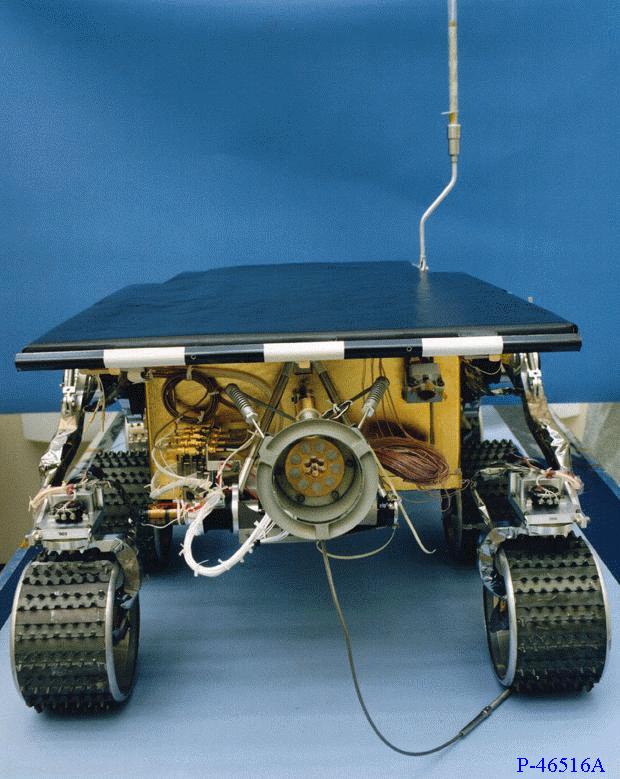
This elemental analysis instrument consists of nine curium-244 alpha-particle sources and three detectors for each of three types of particles: backscattered alpha particles, protons, and X-rays. The APX spectrometer was placed against rocks and soils on Mars to determine the abundances of all elements except hydrogen, with a lower detection limit of about 0.1 weight percent. The analytical process is based on three interactions of alpha particles with matter: elastic scattering of alpha particles by nuclei, alpha-proton nuclear reactions with certain light elements, and excitation of the atomic structure of atoms by alpha particles leading to the emission of characteristic X-rays. The approach used is to expose material to a radioactive source that produces alpha particles with a known energy, and to acquire energy spectra of the alpha particles, protons and X-rays returned from the sample.
 The basis of the alpha mode of the instrument is the dependence of the
energy spectrum of alpha particles scattered from a surface on the
composition of the surface material. The method has the best
resolving power for the lighter elements (carbon and oxygen). A
least-squares analysis of a complex spectrum from an unknown sample in
terms of a library of known, pure element spectra determines the
elements and their abundance in the sample. A characteristic of the
alpha technique is that, due to variations in scattering intensity
with atomic number, there is a minimum in the scattering probability
for elements with atomic numbers between 9 and 14. This includes the
important elements Na, Mg, and Al, so the alpha mode alone is
insufficient for these elements. On the other hand, these elements
produce protons when bombarded with alpha particles. The proton
spectra for alpha particles interacting with elements with atomic
numbers from 9 to 14 are very characteristic of the individual
elements, reflecting the resonance nature of the nuclear interactions
involved. The proton mode allows their detection and measurement. The
alpha particles from the radiation sources are also an efficient
source for production of characteristic X-rays. The addition of a
third detector for X-rays therefore results in a significant extension
of the accuracy and sensitivity of the instrument, particularly for
the heavier, less abundant elements. In the X-ray technique,
characteristic X-rays are emitted when the low electron orbit
vacancies (in the K- and L-shells) produced by bombardment of atoms by
alpha particles are filled by electrons from higher orbits.
The basis of the alpha mode of the instrument is the dependence of the
energy spectrum of alpha particles scattered from a surface on the
composition of the surface material. The method has the best
resolving power for the lighter elements (carbon and oxygen). A
least-squares analysis of a complex spectrum from an unknown sample in
terms of a library of known, pure element spectra determines the
elements and their abundance in the sample. A characteristic of the
alpha technique is that, due to variations in scattering intensity
with atomic number, there is a minimum in the scattering probability
for elements with atomic numbers between 9 and 14. This includes the
important elements Na, Mg, and Al, so the alpha mode alone is
insufficient for these elements. On the other hand, these elements
produce protons when bombarded with alpha particles. The proton
spectra for alpha particles interacting with elements with atomic
numbers from 9 to 14 are very characteristic of the individual
elements, reflecting the resonance nature of the nuclear interactions
involved. The proton mode allows their detection and measurement. The
alpha particles from the radiation sources are also an efficient
source for production of characteristic X-rays. The addition of a
third detector for X-rays therefore results in a significant extension
of the accuracy and sensitivity of the instrument, particularly for
the heavier, less abundant elements. In the X-ray technique,
characteristic X-rays are emitted when the low electron orbit
vacancies (in the K- and L-shells) produced by bombardment of atoms by
alpha particles are filled by electrons from higher orbits.
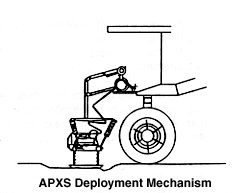 The APXS electronics are mounted in the rover warm electronics box in
a temperature-controlled environment. Cables leaving the electronics
box connect the APXS electronics to the APXS sensor head, which
contains the radioactive sources and particle detectors. The
instrument sensor head is held by a robotic arm (deployment mechanism)
attached to the back of the rover. The deployment mechanism, which
places the APXS in contact with rock and soil surfaces, interfaces the
APXS with the microrover. For the APXS to conduct a high quality
measurement of a rock or soil sample, it must be placed with its front
aperture ring in contact with the sample surface and the axis of the
sensor head must be within 20 degrees of normal to the surface. The
linkage is designed to allow the APXS to be placed at a variety of
elevations above nominal ground level and at a variety of rotational
orientations. The mounting of the APXS to the deployment mechanism
permits about 20 degrees of compliance motion as the APXS is placed in
contact with the sample. Three contact sensors on the deployment
mechanism bumper ring indicate to the rover that the positioning is
complete, thereby terminating the positioning motions. The sources
and detectors are recessed in a cylinder 4 cm behind the bumper and
the area of rock or soil that is analyzed with the instrument is a
circle 5 cm across.
The APXS electronics are mounted in the rover warm electronics box in
a temperature-controlled environment. Cables leaving the electronics
box connect the APXS electronics to the APXS sensor head, which
contains the radioactive sources and particle detectors. The
instrument sensor head is held by a robotic arm (deployment mechanism)
attached to the back of the rover. The deployment mechanism, which
places the APXS in contact with rock and soil surfaces, interfaces the
APXS with the microrover. For the APXS to conduct a high quality
measurement of a rock or soil sample, it must be placed with its front
aperture ring in contact with the sample surface and the axis of the
sensor head must be within 20 degrees of normal to the surface. The
linkage is designed to allow the APXS to be placed at a variety of
elevations above nominal ground level and at a variety of rotational
orientations. The mounting of the APXS to the deployment mechanism
permits about 20 degrees of compliance motion as the APXS is placed in
contact with the sample. Three contact sensors on the deployment
mechanism bumper ring indicate to the rover that the positioning is
complete, thereby terminating the positioning motions. The sources
and detectors are recessed in a cylinder 4 cm behind the bumper and
the area of rock or soil that is analyzed with the instrument is a
circle 5 cm across.
| Instrument Id | : APXS |
| Instrument Host Id | : MPFR |
| PI PDS User Id | : R. Rieder |
| Instrument Name | : ALPHA PROTON X-RAY SPECTROMETER |
| Instrument Type | : SPECTROMETER |
| Build Date | : August 28, 1995 |
| Instrument Mass | : 570 grams |
| Instrument Length | : 10.5 cm |
| Instrument Width | : 8.0 cm |
| Instrument Height | : 6.5 cm |
| Instrument Manufacturer Name | : Max Planck and Univ. Chicago |
Scientific Objectives
The Alpha-Proton X-Ray Spectrometer (APXS) will determine the dominant
elements that make up the rocks and other surface materials at the
landing site. A better understanding of these materials will address
questions concerning the composition of the martian crust and the
processes that led to the formation and alteration of rocks and soils.
This also provides some "ground truth" comparison for orbital remote
sensing observations. Rover mobility allowed the APXS to characterize
the composition of several rocks and soils in the vicinity of the
lander.
Subsystems
The APXS has two subassemblies: (1) sensor head and (2) electronics
box. The sensor head is mounted on the end of an arm on the rear of
the rover called the APXS Deployment Mechanism. The electronics box
is located inside the rover's Warm Electronics Box. The two
subassemblies are connected by electronics cables.
Calibration
The flight sensor head and flight alpha sources were cross calibrated
against the laboratory sources before launch. A laboratory unit,
identical to the flight instrument, is being used in ongoing
laboratory calibration tests to produce the elemental libraries and to
establish instrument performance.
Preliminary composition results were obtained [RIEDERETAL1997B] using just X-ray energy spectra and calibration curves of peak areas versus concentration for several standards measured for each element. Conversion of combined alpha, proton, and X-ray energy spectra to elemental abundances requires further instrument calibration, which is still underway. Alpha and proton modes will be recalibrated at martian pressures.
Operational Considerations
The X-ray detector, when running from batteries at night, provided
excellent data, with resolution of the X-ray peaks even better than
were obtained during the calibration in the laboratory. Most of the
X-ray data on Mars were obtained during the night, when the ambient
temperature was between -50 and -85 degrees C. Because of the low
leakage current at these temperatures, and superb stability of the
X-ray electronics over the entire temperature range, excellent data
were obtained. The gain stability was better than 0.2 channel and
constant resolution of about 260 eV FWHM at Fe-Kalpha line was
observed over the entire period of the mission. After the rover
battery died in the early morning of Sol 56, the noise levels
increased, which increases the uncertainty of elemental abundances of
the low atomic number elements like sodium and magnesium.
Alpha and proton modes provided excellent data on the martian rocks and soils throughout the mission.
On the order of 10 hours integrated measurement time produces high-quality alpha and proton spectra, and about 3 hours are required for high-quality X-ray spectra. All modes (alpha, proton, X-ray) are measured simultaneously when the APXS is powered on and measuring.
Detectors
Detector geometry is shown in [RIEDERETAL1997A]. From a distance
of 3.9 cm from the rock or soil sample (deployment mechanism in
contact), the sample diameter viewed by the detectors is 5 cm.
Electronics
The APXS electronics consists of three analog channels (one for each
mode: X-ray, alpha, and proton). Each channel has its own
preamplifier. The detectors and X-ray preamplifier are the only
electronics in the sensor head; the rest are in the warm electronics
box on the rover. Digital-to-analog converters control the gain of
each of the analog amplifiers. Measurement of the pulse amplitudes is
done using a 10-bit analog-to-digital converter. An 8-bit
microcontroller board with battery backup responds to: commands from
the rover, signals from the analog electronics to perform signal
amplitude analysis and channel storage, and timer signals to increment
a time counter and make temperature measurements. Details of the
electronics are provided in [RIEDERETAL1997A].
Operational Modes
In APXS Night Mode, the rover kept the APXS powered on after a rover
power shutdown occurred, by connecting the APXS directly to the
battery bus. In normal operating mode, this latch between the APXS
and the battery bus was not connected and the APXS could only be
powered on while the rover was powered on.
Measured Parameters
During each measurement session four spectra are accumulated, each
containing up to 256 channels. Each channel consists of two bytes,
organized as an event counter (each channel can contain a maximum of
65535 counts; the channel number corresponds to the amplitude of the
event, i.e. the energy of the registered particle/photon. The first
spectrum, called the "alpha spectrum", contains events registered by
the alpha detector only. The second spectrum, called the "proton
spectrum", contains events registered simultaneously by the alpha and
the proton detector (the amplitude being the sum of the amplitude of
both signals). The third spectrum ("X-ray spectrum") contains events
registered by the X-ray detector and the fourth spectrum ("background
spectrum") contains events registered by the proton detector only.
This fourth spectrum is essentially cosmic ray background events.
Further details are provided in [RIEDERETAL1997A].
Other parameters measured are the temperature of the X-ray preamplifier in the sensor head, temperature of the alpha detector preamplifier in the rover's warm electronics box (°C), and the sampling duration of the alpha, proton, and X-ray measurements (hh:mm:ss).
Related Information
The following links provide some additional information about topics
related to the Mars Pathfinder mission. You must be connected to the
Internet for most of these links to work, since they are located at
the Central Node of the Planetary Data System.
MissionMars Pathfinder
TargetsPDS Welcome to the Planets: MarsPDS High Level Catalog: Mars
Instrument HostMars Pathfinder Rover
InstrumentMars Pathfinder Rover Cameras
|
Data Set DescriptionsAPXS Raw DataAPXS Oxide Abundances Rover Camera Raw Data Rover Camera Calibrated Images and Mosaics Rover Engineering Data ReferencesRIEDERETAL1997ARIEDERETAL1997B
|